Alchemy Bakery · March 7, 2026
On glaze, and why it cracks when you rush
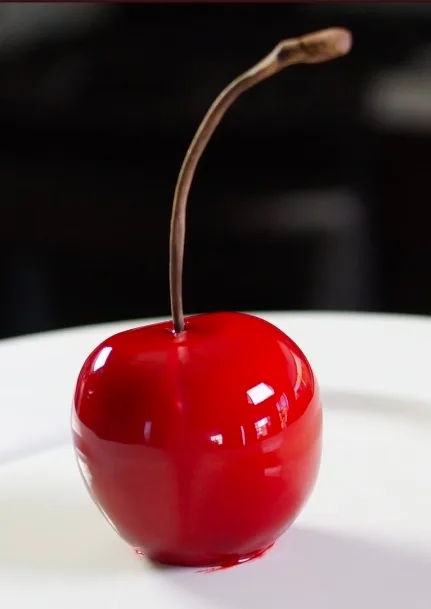
The first lesson with mirror glaze is that it doesn’t actually want to be glossy. It wants to be matte and broken. Glossy is what you have to coax out of it.
The recipe is simple enough — gelatin bloomed in cold water, sugar and glucose cooked to the soft-ball stage, condensed milk, white chocolate, color. You whisk it together, you blend it smooth, you cool it down, and then you pour it. Five ingredients, six steps, sounds like a quick win. The catch is the temperature. Mirror glaze sets at 32°C, and that’s not a range — it’s a point. At 35°C the glaze runs off the dome before it can grip; at 28°C it pours like pancake batter and stripes the surface as it falls. Five degrees in either direction and the piece is wrong.
We use a digital probe. The pour happens with a thermometer in the bowl, and we adjust by holding the bowl over a warm-water bath or by stirring through a few cubes of ice — never reheating, because reheating breaks the emulsion and you can see the slick of cocoa butter rise to the top within twenty seconds. Once the slick is there, you can blend again, but the glaze loses some of its mirror. It looks fine in good light. In bad light you can read the glaze.
The other thing about mirror glaze is that the entremets has to be frozen solid when it goes under. Frozen so cold the glaze flashes the moment it touches the surface — that’s what locks the gloss. If the cake is even slightly soft underneath, the heat conducts upward, you get a halo of cloudiness around the equator of the piece, and that’s the whole afternoon’s batch with a flaw.
Once it’s poured, you don’t touch it. You don’t move the rack. You don’t open the cooler door for ninety seconds. The glaze is making decisions about itself in those ninety seconds — the surface tension is finding its level, the gelatin is grabbing the cocoa butter, the air bubbles are committing to wherever they ended up. We learned this by trying to walk past the rack too fast. The vibrations leave a ripple. You can see the ripple under the morning light.
This is the thing that almost no recipe tells you. The glaze isn’t slow because the math is hard. It’s slow because the physics is fussy. We wait, because the alternative is that you’d see the wait when you cut into the piece.